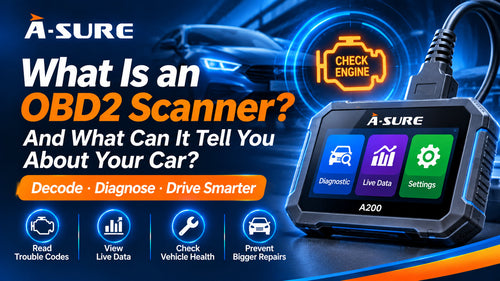
What Is an OBD2 Scanner and What Can It Tell You About Your Car?
- an November 23, 2026
- Kategorien: Car Stereo
ASURE AUTOMOTIVE TECHNOLOGY
What Is an OBD2 Scanner and What Can It Tell You About Your Car?
A beginner-friendly guide to vehicle diagnostics, trouble codes, and smarter automotive maintenance.

Have you ever seen the check engine light appear on your dashboard and wondered what is happening under the hood?
An OBD2 scanner can help you access diagnostic information from your vehicle's onboard computer. Instead of guessing what might be wrong, you can use diagnostic information as a starting point for understanding a potential issue.
1. What Is OBD2?
OBD stands for On-Board Diagnostics. OBD2 is a standardized vehicle diagnostic system used by many modern vehicles.
Through a compatible diagnostic port, an OBD2 tool can communicate with supported vehicle systems and retrieve diagnostic information.
The diagnostic port is commonly located underneath the dashboard, although its exact position varies by vehicle.
2. What Can an OBD2 Scanner Do?
Depending on the scanner and vehicle compatibility, an OBD2 diagnostic tool may provide access to functions such as:
- Read diagnostic trouble codes: Retrieve supported fault codes stored by the vehicle.
- Understand warning lights: Use diagnostic information to investigate issues associated with warning indicators such as the check engine light.
- View supported vehicle data: Access available live data or diagnostic information when supported.
- Support troubleshooting: Help narrow down possible areas that need further inspection.
Available functions vary by diagnostic tool, vehicle make, model, year, and supported systems.
3. What Is a Diagnostic Trouble Code (DTC)?
A Diagnostic Trouble Code, or DTC, is a code generated by a vehicle's onboard diagnostic system when it detects a condition that meets specific diagnostic criteria.
These codes help technicians and vehicle owners identify where further investigation may be needed.
However, a trouble code does not always identify one exact failed component. A single code may have several possible causes, including wiring, connectors, sensors, or other system conditions.
4. How to Use an OBD2 Scanner
Although the exact process depends on the diagnostic tool, a typical scan follows these steps:
- Locate your vehicle's OBD-II diagnostic port.
- Connect a compatible diagnostic scanner according to its instructions.
- Follow the device's power and ignition instructions.
- Allow the scanner to communicate with the vehicle.
- Select the available diagnostic function.
- Review the retrieved diagnostic information.
Always follow the instructions supplied with your specific diagnostic device and vehicle.
5. Can an OBD2 Scanner Fix My Car?
An OBD2 scanner is a diagnostic tool, not a mechanical repair device.
It can help you access information and understand potential problems, but it does not physically repair a faulty sensor, damaged wire, mechanical component, or other vehicle issue.
Some diagnostic tools may provide additional functions, but these depend on the device and vehicle. Always verify the supported functions before relying on a tool for a specific repair task.
6. Why Choose an AI-Assisted OBD Experience?
Traditional diagnostic information can be difficult for beginners to understand. An AI-assisted diagnostic experience aims to make technical information easier to review and understand.
With a compatible device and the required internet connection, AI-related features may help users explore diagnostic information in a more accessible way.
AI insights are intended to support understanding and troubleshooting. They should not replace professional diagnosis, manufacturer service information, or qualified repair work.
7. Discover the ASURE A200
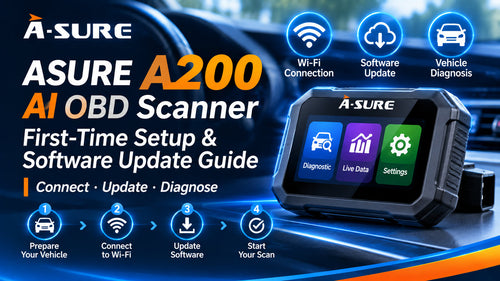
The ASURE A200 brings an AI-assisted approach to the OBD diagnostic experience. For the best first-use experience, connect the device to Wi-Fi and install available software and diagnostic database updates before your first scan.
AI insights require internet access and a compatible smartphone. Available diagnostic functions depend on vehicle compatibility and the product's supported capabilities.
8. Who Should Consider an OBD2 Scanner?
- Drivers who want to better understand vehicle warning lights.
- Car owners interested in basic vehicle diagnostics.
- DIY automotive enthusiasts who want diagnostic information before further inspection.
- Drivers who want a more informed starting point when discussing vehicle issues with a mechanic.
Explore Smarter Vehicle Diagnostics with ASURE
Discover the ASURE A200 and explore our automotive technology solutions.
Explore ASURE New ProductsNeed help? Visit our Help Center.
Über den Autor